
FULL ORDER
ORDERING PROCESS OF MADE-TO-ORDER JEANS
How to Order


First, our dedicated fitting specialist, or "fitter," will explain the ordering process and available alterations. We will listen to each customer's requests and create an order sheet. This consultation is the most important step in the entire process. While we'll certainly discuss what kind of jeans you want, the enjoyable casual conversations during the consultation, about your personality and what inspires you, also provide clues to possibilities and expressions for creating the perfect custom-made jeans for you.


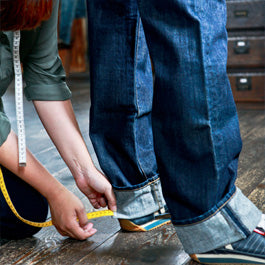
When you place your first order, you will first try on a sample. Men's sample waist sizes are available in 10 sizes for selvedge slim straight, from 28 to 40 inches. We also offer slim straight in 15 sizes, from 28 to 50 inches. Women's sample waist sizes are available in 10 sizes for slim straight, from 26 to 38 inches. Please choose your preferred silhouette with the fitter. In addition, based on the basic silhouette, it is possible to make pattern adjustments such as deepening the rise, tapering, or flaring as an option. The fitter will listen to your requests regarding fit. The fitter, based on knowledge accumulated over many years, will ultimately propose your just size, taking into account shrinkage from washing and the type of fabric you choose thereafter.

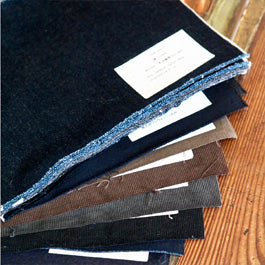


Next is fabric selection. We always have about 40 types of materials available, including original fabrics and trendy seasonal items. In addition to basic 14oz denim, we also offer vintage selvedge denim, natural indigo dyed denim, traditional Japanese gold-thread denim, soft denim, and the latest stretch denim. Furthermore, trendy colored materials appear each season.


You can select all the basic parts such as front buttons, rivets, leather patches, and stitching thread in your favorite combination. For the front closure, you can choose between a zipper fly or a button fly. Please be assured that if you are overwhelmed by the many options, our fitters will suggest recommendations from our selection.


A unique feature of jeans, and a major source of enjoyment in ordering custom jeans, is the finishing process. We offer a variety of finishes, such as whiskering, washing, and distressing, which will be a fresh experience even for those accustomed to ordering tailored suits. Our staff will carefully listen to your vision and then concretize and present it to you.


Customers who wish can also order optional parts for an additional fee, such as embroidery of initials and buckles. Now that you've reached this point, your order is complete. Please wait a short while for your custom-made jeans to be finished.
Production process


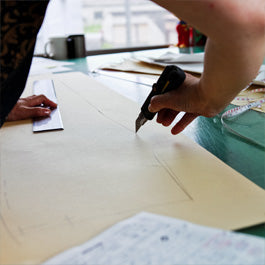
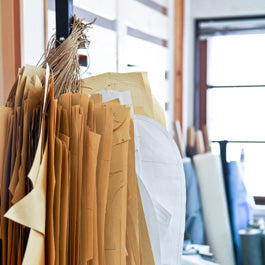
Once the order sheet is complete, the order jeans production team at the Kojima head office begins creating the specifications and patterns. We confirm each of our customers' requests to create a specification sheet for their one-of-a-kind jeans, which is essentially a "blueprint." For customers who require pattern adjustments, we create a "personal pattern" tailored to their requests, based on "master patterns" carefully selected from years of experience. We adjust subtle lines while envisioning the finished product, drawing lines for each part and manually cutting each pattern, taking into account various requests such as pocket shape, rise position, and thigh, knee, and hem sizes. It takes approximately one week for the "specification sheet," which contains instructions for each process, and the patterns to be ready for "cutting." For repeat customers, all patterns are stored for one year after completion. The vast collection of approximately 20,000 patterns is a testament to DENIM WORKS and will continue to grow.


While the fashion industry increasingly uses CAD and automatic cutting machines for fabric cutting, DENIM WORKS continues to hand-cut all denim fabric directly. This is because, for made-to-order jeans finished one pair at a time, mass production methods using large cutting machines are inefficient and would actually delay completion. Skilled cutting craftsmen can instantly determine the necessary amount and orientation of denim fabric for a pattern, and then hand-cut the subtle lines of the pattern with astonishing speed. This technique is a unique asset of DENIM WORKS, inheriting the tradition of Japanese-made jeans since the 1960s. The tools used for hand-cutting are handmade "chisels." We use chisels of different widths depending on the type of fabric, and continuously sharpen them to maintain their keen edge.


In addition to materials such as denim fabric and thread, jeans also require accessories like buttons, rivets, and leather patches. Zippers, in particular, are a crucial component in sewing specifications because their standards change according to the "personal pattern," and sewing cannot proceed without them. Furthermore, to accommodate orders for buttons and rivets that are not in stock, we also search for and order from the manufacturers' inventories of each part. This process requires knowledge and experience regarding parts to ensure a stable supply of custom jeans. In Kojima, Kurashiki City, where the textile industry thrives, there are many manufacturers of jeans parts and label companies. The trust relationship cultivated between these related companies and Betty Smith is the foundation for the development of custom jeans, supporting a highly flexible service with small lots and wide variations.


Once the cut denim fabric and components are ready, we proceed to sewing. For our standard 5-pocket jeans, the sewing process can be broken down into various techniques such as double-stitched flat-felled seams, plain seams, double-row plain seams, interlock stitching, overlock stitching, hem folding, and loop stitching. Each of these sewing techniques requires a specific sewing machine and its unique settings. We use different machines, and once the garment takes shape, we finish by hemming with a Union Special chain stitch machine and attaching belt loops and creating buttonholes with special machines. In typical mass production sewing, these processes are divided among different workers. However, it is difficult to divide the sewing of custom-ordered jeans, where each pair is unique, so at DENIM WORKS, one sewing artisan is responsible for one order. Even veteran artisans with over 40 years of experience can only complete an average of 3 to 4 pairs a day, working all day.


Once the sewing is complete, we attach the buttons and rivets to your custom jeans as a finishing touch. The moment we attach the chosen hardware from a wide selection to the jeans is truly the highlight of completing a pair of jeans, reflecting their workwear origins. Among the rivets and buttons, some are rare, handcrafted one by one by artisans in Asakusa. These details can be appreciated by vintage-savvy jeans enthusiasts and offer the enjoyment of modern detailing. They are also important components that give jeans their individuality, in addition to the fabric and silhouette. While in the past, these were attached using manual or foot-pedal machines, DENIM WORKS uses semi-automatic attachment machines to ensure precision.

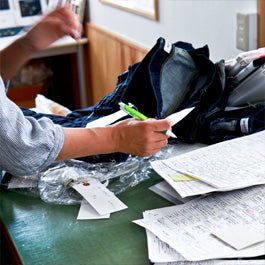


Our dedicated DENIM WORKS inspection staff carefully measures and inspects each pair of completed custom jeans against the order sheet. If you ordered the "washing process" option, the pattern size is made larger in advance to account for shrinkage after processing, so the finished size will differ depending on whether or not it is processed. In the case of "washing process," hemming is also performed again after processing. Therefore, the staff repeatedly inspects the jeans, from measuring to ordering the processing, and then measuring after processing, to confirm the size down to the smallest detail. If you ordered the "distress processing" option, local craftsmen also manually process each item. They carefully check the order sheet to ensure that the finished product meets the order.


After the final inspection, the fitter themselves perform one last check. On average, it takes more than 30 days from the completion of the order sheet to this point for the custom jeans to be finished. Once the custom jeans are complete and have their dedicated custom jeans tag and attention tag (handling precautions) attached, they are finally packaged. The custom jeans, embodying the skill of each artisan, are wrapped in non-woven fabric and then shipped to the customer. The level of perfection and price range of these custom jeans, made possible by Betty Smith, a company with its own domestic factory, is supported by the experience and technical expertise of its artisans.